
Is Europe falling behind in artificial intelligence – or is the industrial catch-up just beginning?
Anyone involved in AI quickly encounters a familiar narrative: the major breakthroughs are happening elsewhere. In the U.S. and Asia, tech companies are investing billions in data centers, platforms, and foundation models. In this picture, Europe often appears as a bystander – strong in regulation, but weak in scaling and speed.
However, this narrative falls short. It views artificial intelligence primarily as a matter of technology and capital. In industrial reality, however, value is created in a completely different place: where technology meets application.
Europe – and mechanical engineering in particular – brings precisely this strength to the table.

For a long time, AI was indeed one thing above all else: expensive. Anyone who wanted to train powerful models needed enormous computing power, specialized hardware, and large amounts of data. Access to AI was thus limited to a few players who had the necessary capital.
These conditions are currently undergoing a fundamental shift. The costs of AI infrastructure are falling, powerful base models are available in standardized form and can be used flexibly. AI is thus evolving from an exclusive high-tech topic into a widely available key technology.
What matters most is no longer who owns the largest model, but who uses it effectively.
For industrial companies, this represents a paradigm shift. Artificial intelligence is becoming less a matter of data centers – and more a matter of engineering.
Why value is created not in the model, but in the application
Foundation models form the technological basis of many AI applications today. They are important, but they are not differentiating factors. The actual added value is created one level above: in the software logic, in system integration, and above all in the concrete industrial application.
This is where the structural advantage of European mechanical engineering comes into play. Companies possess deep application and process knowledge: they understand motion profiles, control strategies, safety requirements, energy flows, and real-world constraints. This knowledge has grown over decades and cannot be replicated in the short term.
Artificial intelligence demonstrates its value precisely where it complements and enhances this knowledge. Not as a replacement for engineering, but as a tool to make complexity manageable, support product diversity, and design systems more efficiently.
While foundation models and platforms are largely established, industrial value is created where motion, automation, software, and application knowledge interact.
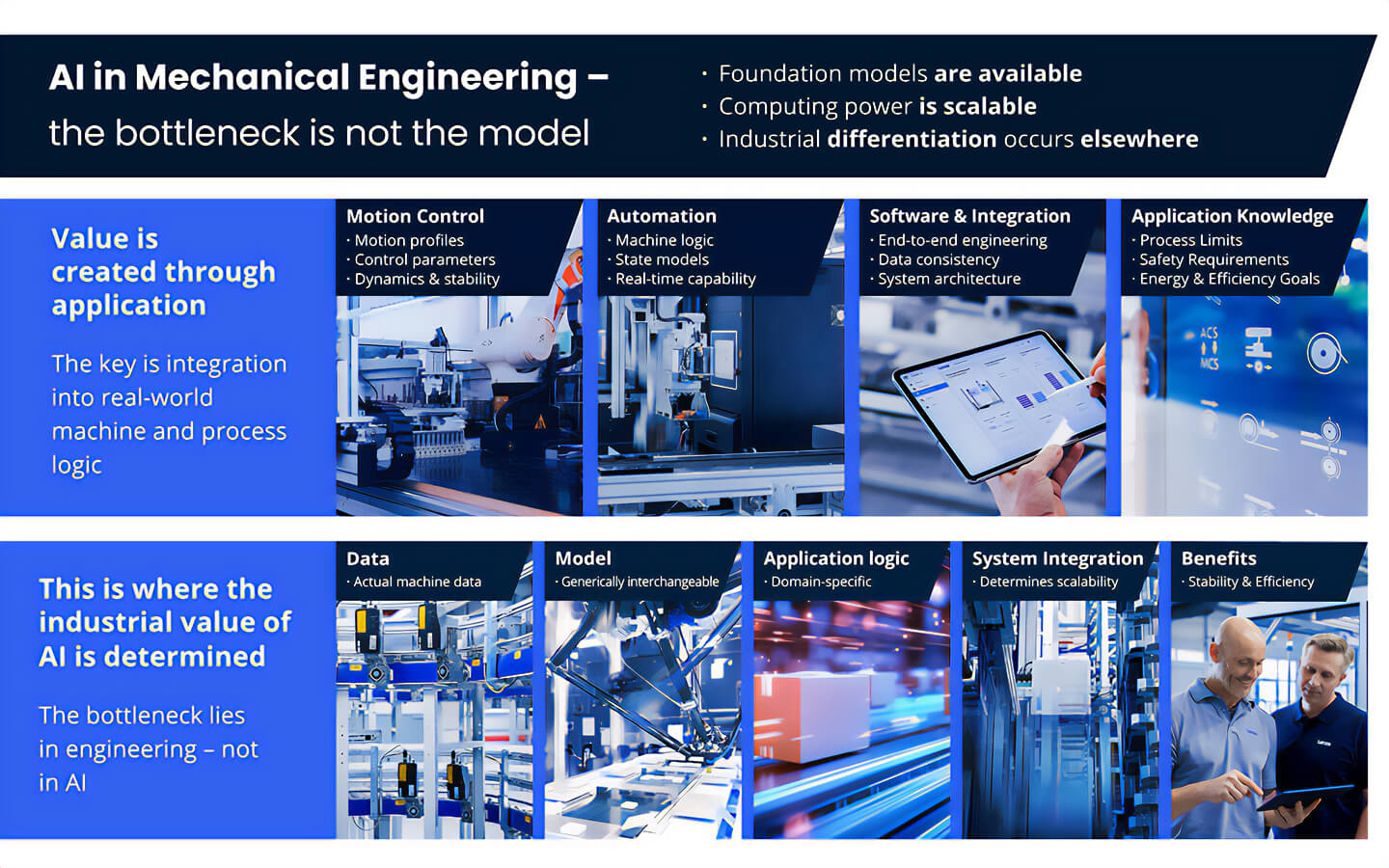
For Lenze, this perspective is not an abstract vision of the future, but daily reality. Motion control, drive technology, automation, and software are precisely the areas where AI takes effect – not in isolation, but in synergy.
Whether it involves designing motion sequences, optimizing energy efficiency, or simplifying complex machine architectures: AI is most effective where it is integrated into existing industrial systems. Not as an additional IT project, but as an integral part of the overall system.
Modular software concepts, end-to-end engineering, and decentralized intelligence create the conditions for deploying AI in a scalable and practical manner. The focus is not on spectacular use cases, but on robust, repeatable solutions that stand up to the rigors of everyday industrial operations.
What industrial companies need to do differently now
However, technological change alone is not enough. What matters is how companies deal with it.
Successful organizations are currently characterized by three things: focus, speed, and organizational integration. Instead of introducing AI broadly and indiscriminately, they concentrate on a few use cases with clear benefits. They accept that learning is more important than perfection – and that early experience is a strategic advantage.
At the same time, it is becoming increasingly clear: AI is not purely an IT issue. Without employee acceptance, empowerment, and involvement, its potential remains untapped. Sustainable value is created where AI becomes part of daily work – as support for engineering teams, not as an isolated expert system.
Companies that adopt this perspective embed AI not only technically but also organizationally.
Now is the right moment for AI in mechanical engineering
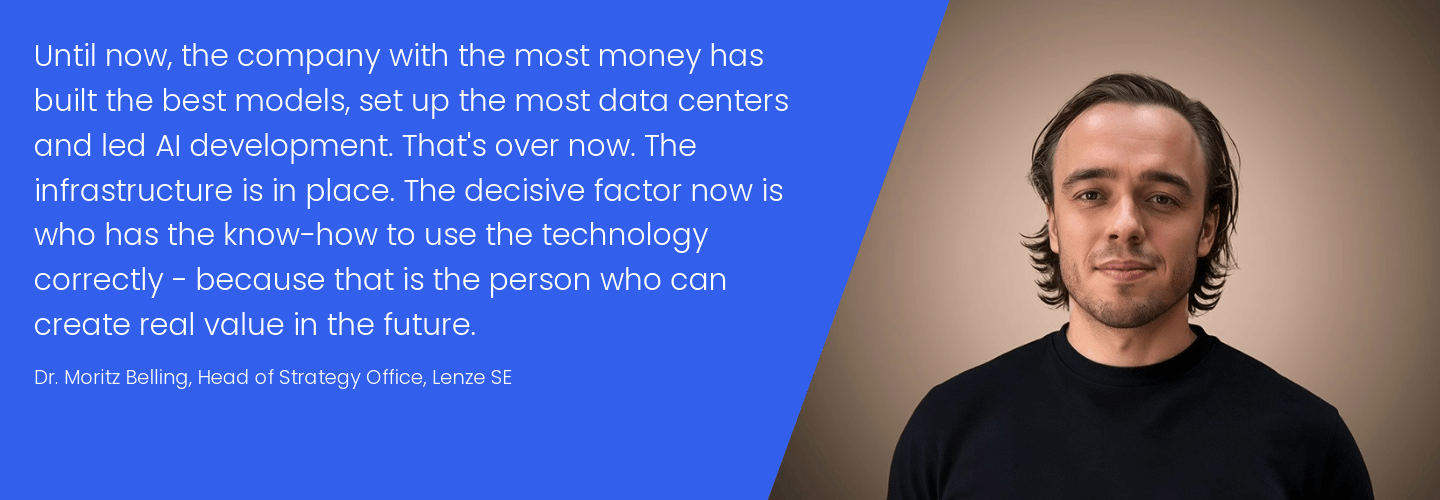
Artificial intelligence is no longer a topic of the future. It has become a widely available technology whose differentiation lies in its application. For Europe and the mechanical engineering industry, this presents a clear opportunity: to specifically combine industrial expertise with modern technology.
It is not the size of a company that determines its success with AI, but its ability to put knowledge into practice.
The window of opportunity is open. Those who act now will gain experience, build expertise, and secure long-term competitiveness – not through the next hype, but through industrial substance.


 沪公网安备 31019002000664号